ClinicOS
The software a clinic runs on, which I designed end to end, and the AI front desk we added to it midway, built around one switch the clinic can’t turn off.
- Role
- Multidisciplinary Design Specialist, COSMO
- Team
- PM, founder, engineers, marketers, paid-media team
- When
- 2026; the AI front desk, March to September 2026
- Status
- Shipped
The call
1 Sketch.
2 Wireframe.
The clinic switches skills on and off. Safety skills can’t be turned off.
3 Shipped.
The clinic can switch off anything the AI front desk does, except the skills that keep patients safe. On the settings screen that rule takes one line: “Safety skills can’t be turned off.”1
I designed that rule and the screen it sits on.
Problem
ClinicOS is the software a clinic runs on: the calendar and booking, client records, charting and EHR, payments, a dashboard and reports. It serves three sides at once: the agency that runs the platform, the clinics on it, and their patients. I designed all of it at COSMO.
The AI front desk came later. Midway through the work on the OS, we saw the room for an agent at the front desk: one that answers clients over web chat and SMS and can “book, move & cancel end to end, over text”.1 The agent was joining a product that already existed, so it had to fit around the calendar, records and payments the OS was built on.
Inside each clinic, the agent answers to three sides of its own. The clinic wants a full calendar, which the shipped product handles with waitlist fills, “no-show rescue, same day” and recalls for lapsed clients.1 Marketing wants clients to come back, and wanted to use their treatment history to bring them. The client wants a quick answer and their health kept private. The hardest part for me was holding the business, marketing and client sides together while keeping HIPAA the priority.
My part
- Designed every screen in the OS. On the AI front desk, I designed the consent gate, the urgent-to-human handoff, and the transcripts and controls.
- Defined the product structure and the release scope.
- Ran requirements with stakeholders, HIPAA among them.
- Built parts of it myself in Cursor, on HeroUI v3.
- Worked with the PM, the founder, engineers, marketers and the paid-media team.
Constraints
- Health information decides what may pass between the clinic, marketing and the client. Under the HIPAA Privacy Rule, using a client’s health information to market to them needs their written authorization; a message about their own treatment is not marketing at all.2
- The agent joined a working product. It had to use the booking, records and payments that were already there.
- One team held opposite goals for the same data: marketing wanted treatment history for campaigns, and the client side needed it kept private.
- The clinic owner has to stay in charge of an agent that talks to their clients day and night.
Decisions
Red marks a call I made. Grey marks a team call I worked on.
The safety floor stays on
The clinic can pause the front desk, switch a channel off, and turn individual skills on or off. The safety skills are the exception. They stay on whatever the settings say. The other way to build it was full owner control, where every switch works.
Trade-off: owners give up a little control over their own front desk, and in return no setting can remove what protects a patient.
Consent before anything personal
General questions get an answer straight away. Before the front desk says anything about a specific patient, it captures consent; the shipped product describes it as “consent captured before any patient-specific answer”.1 I designed that flow and its screens.
Trade-off: one more step before some bookings, in exchange for an agent a clinic can trust with its clients.
Urgent goes to a person
“Urgent or clinical situations page a human instantly.”1 I designed the handoff. On a live call, staff can listen in, and can take over at any point.
Trade-off: the agent hands over conversations it might have handled, and in return every clinical moment reaches a person.
I’ve had swelling and a fever since this morning, a few days after my appointment.
That needs a person, not me. I’ve alerted the front desk team now, and someone will call you shortly.
Handed to staff. The AI stopped replying.
The clinic can always see it and stop it
Every action the front desk takes is logged with a full transcript, “searchable and exportable”.1 Staff can open any entry to see what the agent did, read the transcript, play the recording and flag it for review. The clinic can pause the agent, or switch web chat or SMS off on its own, at any time. The safety floor is the one limit on that control.
Trade-off: more controls to design and to explain, so that the owner, and never the agent, is in charge.
Live call
AI front desk, with a caller on their mobile
Thanks for calling, this is the AI front desk. How can I help?
Hi, I need to move my Thursday appointment, something came up at work.
No problem at all. I can do Friday at 11:00 or Monday at 2:30. Any preference?
The AI is handling this call. Staff can step in at any point.
Activity log
Running. Every action is listed here, and you can stop it at any time.
- Booked a consult with a providerText
- Answered a question about payment plansChat
- Booked an appointmentCall
- Offered a freed slot to the waitlistText
- Handed an urgent message to staffStaff
Handled by the AI front desk.
What the AI did
- Answered on the first ring
- Matched the request to the service menu and live availability
- Confirmed timing, preparation and pricing
- Booked it, texted a confirmation and logged the call
Transcript Recording, 2:14
Thanks for calling, this is the AI front desk. How can I help?
Hi, do you have anything for a facial this week?
We do. Thursday at 2:30 or Friday at 11:00. Which works better?
Thursday 2:30, please.
Care kept apart from promotion
Not my call: the idea came from someone else on the team. I came up with many of the ways to make it work for marketing, the clinic owners and the clients booking their appointments, the consent gate among them.
Marketing wanted to use clients’ treatment history. Care reminders stay apart from promotions, because the Privacy Rule treats them differently: a reminder about a client’s own treatment is care, and a promotion built on their health information needs their written authorization.2
Shipped
ClinicOS went to pilot clinics first, then shipped. The patient side opens on a four-step booking flow: choose a service, pick a visit type and time, add details and pay, then confirm.
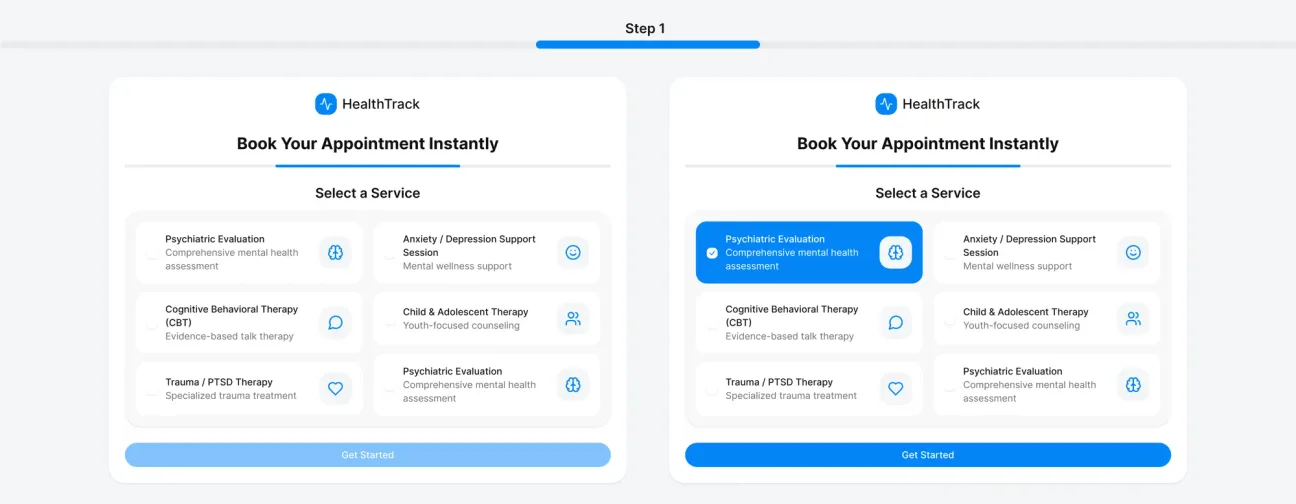 Selected: the whole row turns blue
The map of the whole product is below. Any clinic name or figure in it is sample data, not a result.
Dashboard Today
- Sam R.ConsultRoom 1
- Ari K.Follow-upRoom 2
- Noor T.TreatmentRoom 1
Calendar Week
Inbox Text and email
- SRSam R.Can I move to Thursday?
- AKAri K.Thanks, see you then
- NTNoor T.Is parking on site?
Client record
Payments and reports
- Invoice 1042$85.00Paid
- Deposit$40.00Due
AI front desk On
Caller wants to move a visit
- Booked a consult
- Moved a visit
- Answered a question
- Sent a reminder